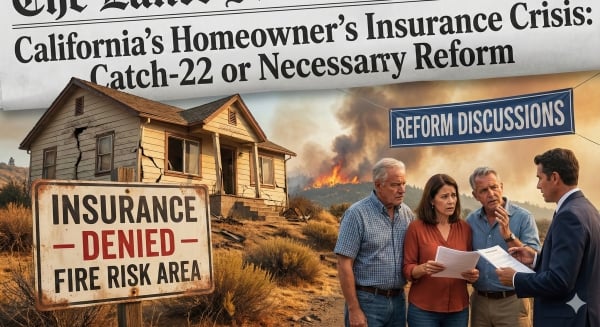
The area I sell real estate is a triple threat of insurance nightmares. The Hayward Fault runs through the area, in 1991 it was the location of one of history’s largest urban firestorms, and a multitude of seasonal creeks require flood insurance.
Insurance coverage is such an issue that the California purchase agreement forms have an insurance contingency in place since June of 2024. Buyers walk into open houses thinking about quartz counters and school scores not hip to the fact that insurance is now another hurdle to homeownership.
For most of the last 35 years, California pulled off a neat trick: high natural disaster exposure with below‑average insurance premiums. Proposition 103, passed in 1988, required prior approval for rate increases and forced insurers to base rates primarily on historical loss data instead of forward‑looking catastrophe models. It also made the Insurance Commissioner an elected office, with a clear consumer‑protection mandate.(PPIC)
That framework worked for a long time. Homeowners enjoyed cheap coverage, big national carriers were happy to write business, and few people outside the industry thought much about how it worked.
And then
The 2017 and 2018 wildfire seasons weren’t just bad years; they broke the underlying math. Insurers saw loss ratios well over 100%—meaning they were paying out more in claims than they collected in premiums—especially in wildland‑urban interface zones.(Good Life Mgmt)
At the same time, construction costs and reinsurance costs were climbing, so every dollar of coverage became more expensive for the carrier to stand behind.
Insurance companies, looking at three converging lines: bigger fires, higher rebuild costs, and regulations that wants them to pretend tomorrow looks like the last 30 years decided California wasn’t worth the trouble and the response from the majors was predictable.
Starting around 2018, companies like State Farm, Allstate, QBE and others began quietly pulling back—pausing new policies, tightening underwriting, and then flat‑out non‑renewing in higher‑risk ZIP codes.(PPIC)(UC)(SF Chronicle)By the early 2020s, the retreat had become structural, not tactical. They wanted out.
CA’s FAIR ACT
The California FAIR Plan was designed as an insurer of last resort—bare‑bones fire coverage for people who couldn’t get a standard policy. It was never meant to carry a big chunk of the state’s housing stock.
But between September 2020 and September 2024, FAIR Plan policy counts jumped by roughly 123% as non‑renewed homeowners got shoved into limited, expensive coverage just to keep their loans compliant.(Good Life Mgmt)
For several years, the state watched this play out. The result was a quiet but very real affordability crisis sitting on top of the housing affordability crisis we already had.
In 2024–2025, the Insurance Commissioner finally made a move—and this is where the Catch‑22 question shows up.
Sustainable Insurance
Under the “Sustainable Insurance Strategy,” California started to unwind the strictest parts of the Prop 103 framework. New regulations now allow insurers to use forward‑looking catastrophe models and to include the net cost of reinsurance in their rate filings—tools they’d been asking for since the fires started behaving more like climate events than random bad seasons.
In exchange, carriers that use these tools are supposed to do something Californians actually care about: write more policies in high‑risk areas and help move people off the FAIR Plan over time.
On paper, it’s a necessary reform. If you want private carriers to come back, you have to let them charge something close to what the risk really costs.
In practice, it feels like a shakedown to anyone holding a renewal notice.
So is this a Catch‑22 or necessary reform?
The new rules recognize the climate reality but dump the adjustment cost directly onto individual homeowners, many of whom bought their properties under a completely different risk‑pricing regime.
There are some early signs the reforms are doing what they were supposed to do. Farmers just lifted its cap on new California homeowners policies, which you don’t do if you think the market is unworkable.
Smaller and regional carriers are applying to pick up blocks of non‑renewed business. The FAIR Plan’s expanded role is time‑limited through 2028, which suggests regulators expect the private market to stabilize by then.
But none of that changes the math for a family in the hills whose premium just doubled.
Article Originally Published