
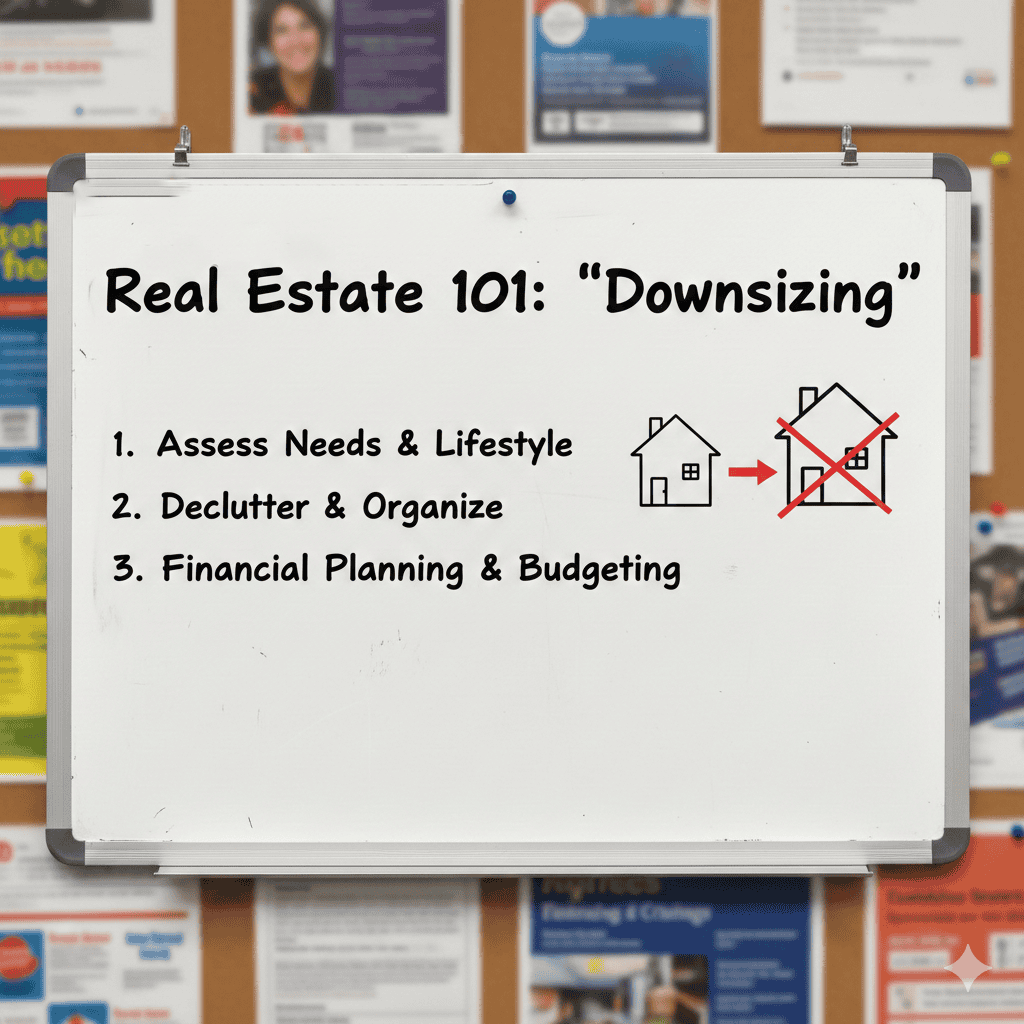
Downsizing: Simpler, Not Smaller
Most downsizing conversations go off the rails in the first five minutes. Either someone starts selling you "lock and leave luxury" or you get buried in tax jargon and loan acronyms until your eyes glaze over.
This is the middle path. No sales pitch, no alphabet soup. Just a clear walk-through of what actually changes when you sell the home you have and buy something that fits your life better now.
When you strip away the noise, most long-time owners are really asking three questions.
What happens to my equity?
What happens to my property taxes?
What happens to my day to day once I move?
What “Downsizing” Means
Downsize defined as, “move to a smaller place of residence”, doesn’t carry the gravitas necessary to define such a monumental decision—so we added a gerund “ing” which provides a lot more room to interpret. Downsizing is not punishment, and it is not always about going smaller. It is about going simpler.
For some people that means fewer stairs and one good bedroom near the kitchen. For others it is less yard and less weekend spent chasing gardeners and roofers. For a lot of my clients, it means trading "the family house" for a place that works for the way they actually live now instead of the way they lived twenty years ago.
You can downsize square footage, you can downsize maintenance, you can downsize stairs, you can downsize distance to grandkids or doctors. You can you make your life bigger by downsizing.
Equity
Equity is just the gap between what your home would sell for today and what you still owe on it. If your home would sell for 1.5 million dollars and your remaining loan is 400,000 dollars, you are sitting on 1.1 million dollars of gross equity.
When you sell, that 1.5 million dollars does not drop straight into your checking account. Out of those proceeds you pay off the existing loan, pay your selling costs, and then what is left becomes your net equity.
Selling costs are real and you want them in the picture early rather than as a surprise. In California a approximate about six to eight percent of the sale price once you add together brokerage commissions, transfer taxes, title, escrow, and basic prep. On 1.5 million dollars, that is somewhere in the 90,000-to-120,000-dollar range. The exact number depends on commission structure and local transfer taxes. You can use a net proceeds calculator to get a better idea of cost and fees in your area.
Net cash in your pocket around 1,000,000 dollars
Then the next question shows up immediately. How much of that do I actually keep after taxes.
Capital Gains Taxes
For a primary residence, the IRS lets you exclude up to 250,000 dollars of gain if you are single and 500,000 dollars if you are married filing jointly. You must have owned and lived in the home for at least two of the past five years. That exclusion is in Section 121 of the Internal Revenue Code and spelled out in IRS Publication 523 on selling your home, which is worth a quick read before you start running numbers in your head.
If your gain fits under that exclusion, federal capital gains tax on the sale of your long-time home often ends up being zero. California still taxes capital gains as ordinary income, but even then most long-time owners are surprised at how much of their check they actually keep once the dust settles.
Property Taxes
This is the part that kept a lot of Californians trapped in their homes for years. You bought in 1985, your Proposition 13 tax base is peanuts, and the idea of moving and having your tax bill jump to current value made downsizing feel unrealistic.
Propositions 60 and 90 were the first band-aids. They let owners 55 and over move a low tax base within a county or into a handful of "receiving counties," but the rules were strict and the list was short.
Proposition 19, which voters passed in 2020, changed that in a big way. Homeowners 55 and older, people with severe disabilities, and certain disaster victims can now take their existing tax base almost anywhere in California, up to three times in a lifetime. The Board of Equalization's Prop 19 overview lays out the ground rules in plain English.
Proposition 19
You bought your current home for 600,000 dollars years ago. Your tax bill today is based on that 600,000 dollars, plus modest annual increases. The home is now worth 1.8 million dollars.
You sell for 1.8 million dollars and buy a new home for 1.7 million dollars closer to where you actually want to be. You can transfer that old 600,000-dollar tax base( thank you CA Proposition 13 )to the new property. Your taxes on the new home stay roughly where they were, instead of jumping up to the full 1.7-million-dollar value.
If you buy up, the math adjusts but the principle is the same. Sell for 1.8 million dollars, buy for 2.1 million dollars, and your new assessed value becomes your old 600,000-dollar base plus the 300,000-dollar difference. You pay full freight only on that gap, not on the entire 2.1 million dollars. That example comes straight out of San Francisco’s county assessor guidance on Prop 19 implementation.
The key points are simple. You must be 55 or older. The home you sell and the one you buy both have to be your primary residence. You have a two-year window to complete the move. And you have to file the right form with the assessor, usually called BOE-60-A, within the timelines they specify.
New and Different
A close friend used to say to when advising on changes, “I can’t promise new and improved but I can promise different.”. This is the part the spreadsheets cannot calculate.
When you leave the big house, you are not just changing rooms. You are changing your daily workload. Fewer bathrooms to clean. Less roof to worry about. Smaller water bills. Fewer "Sunday projects" that somehow eat the whole weekend.
Most of my downsizing clients are not trying to move into perfection. They are trying to reclaim some time. Less house means more time to travel, to see grandkids, to say yes to a long lunch without feeling guilty about the yard or the gutters or worried you’ll be on cat food at 95.
If you pick the right next home, day to day life usually gets quieter and cheaper at the same time. That does not show up on a closing statement, but it absolutely shows up in your quality of life.
Three frogs on a log… one made a decision to jump; how many frogs are there
Yes, there’s still three frogs on the log because one of them made a decision to jump.
You do not need to be ready to move tomorrow for this to be worth thinking about.
The real value is knowing your levers in advance. Roughly how much equity you would unlock if you sold. Whether most or all of your gain would be sheltered under the IRS primary residence exclusion. Whether Prop 19 would let you carry your current tax base into the next home. Whether you want the next chapter of your life to be mortgage free, or whether preserving cash matters more than eliminating a payment.
Once you see those levers clearly, the decision shrinks from "should I blow up my life" to "does a move buy me more control over my time, my cash flow, and my stress level than staying put."
Downsizing is not about giving something up. Done thoughtfully, it is about cashing out of a house that fit an earlier version of your life and buying one that fits the version you are living now.
You only have to do the math once to see whether that trade makes sense for you.
I have helpful tools on my site to help you get an idea about your home’s value and neighborhood activity. Check it out here: americasells.com