
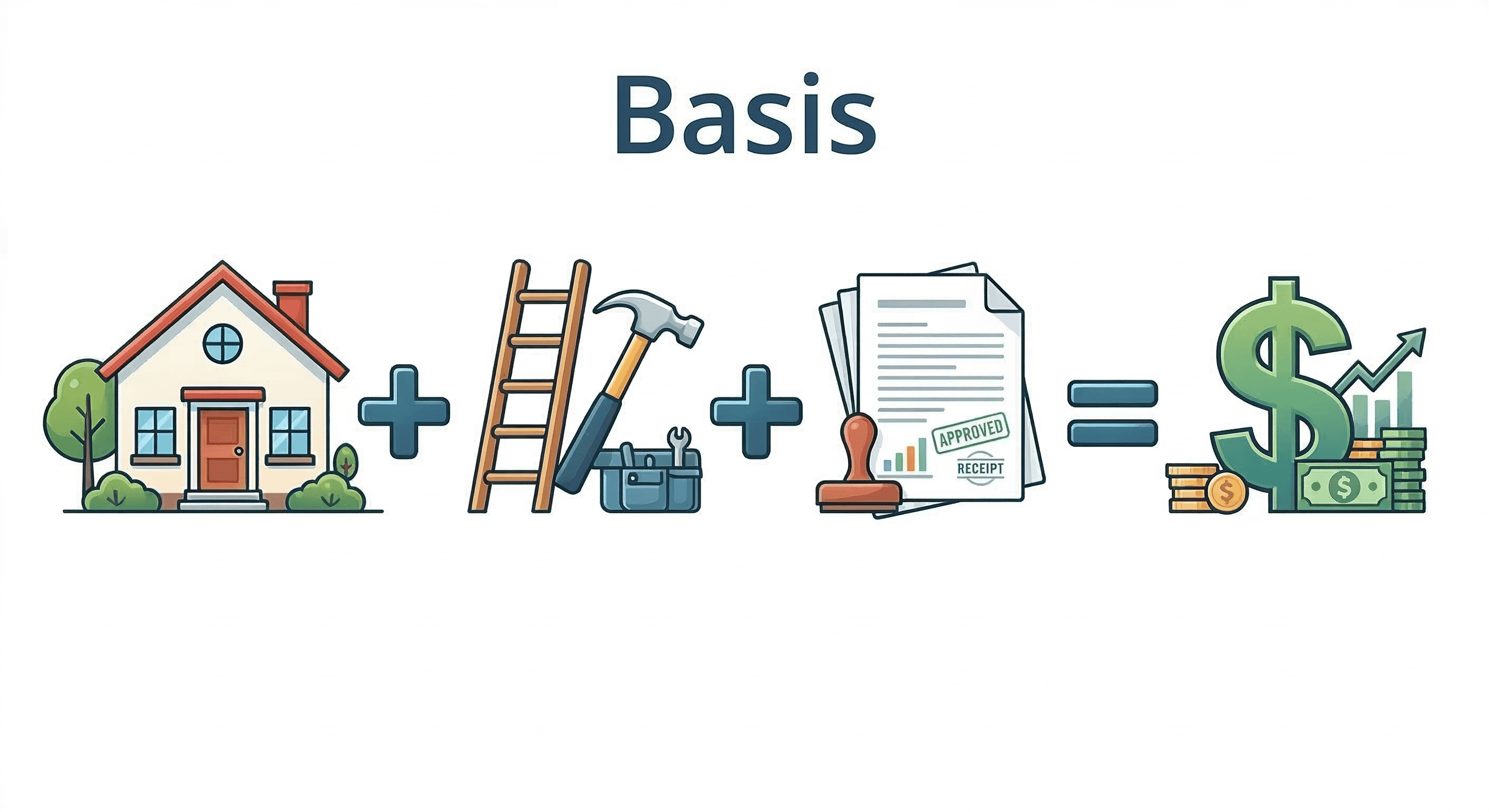
There is a lot of real estate topics agents don't talk about because, A) no one really knows anything about the topic, and B) it isn't "sexy." There are no glossy photos, no vanity videos, pod casts, bidding wars, and no closing day champagne. But basis is what keeps the tax man from taking a bigger slice of your pie than he's legally entitled to.
And of course, since I kinda know about it (but as some of you may know “a little knowledge is a dangerous thing”) and a client asked me about it the other day, I am writing an explainer, because that’s something I do to provide value while not looking like a complete idiot.
The reason I know about Basis is one of my clients asked me why they ended up paying so much in capital gains (I am that good, they bought a place with me and when I sold it 8 years later realized more than 500k gain) after being married and in the house so long. I sputtered something about basis and depreciation and “I’m not a CPA”.
And I am not a CPA, but I could have done better for my client if I had had a better understanding of basis and how it works when selling a property when I went to take the listing the first time.
Fast forward, here we are again, and fingers crossed they're going to see another nice equity jump. But this time when I head over to the listing appointment, I’ll have a better idea of basis and how it works—I’ll even have a nifty worksheet (it’ll be on my website at some point soon too) they can use to help them.
Basics of Basis
Basis is simply your original cost of the property (purchase price) adjusted for qualifying additions (renovations and improvements) you made over time. Basis is equal to the purchase price of the property PLUS the costs of the improvements that, and here’s the important part, add value (r extend the life of (think kitchen renovation, adding a pool or a second story) as explained in IRS Publication 523, selling your home.
When you sell, your taxable gain is the sale price minus that adjusted basis, so the higher your documented basis the smaller your taxable gain. Keep invoices, contracts, and proofs of payment for major projects because those records are what let you add those costs to basis and reduce the tax the sale generates (for a practical rundown see TurboTax’s guide on home improvements and taxes.
Vocabulary
Let me start with definitions, because the IRS isn't known for its sense of humor when it comes to terminology. The IRS has been kind enough to produce a guide, IRS Publication 523, which I used for research.
Your Cost Basis is your starting point. This is what you paid for the house when you bought it, plus any major capital improvements you've made since.
Your Adjusted Basis is your starting basis plus the sum of all your qualifying capital improvements. This is the real number. It's what you've actually sunk into the asset over the years.
Your Capital Gain is the difference between your net sale price and your adjusted basis. If you sell for $1.5 million and your adjusted basis is $1 million, your gain is $500,000. That $500,000 is what gets taxed.
Math
Here's the math made simple.
You buy a house for $500,000. Over the years, you put $200,000 into it—kitchen, roof, addition, systems. You sell for $1.8 million.
Without documenting your improvements, your gain is $1.3 million. Federal capital gains tax at 15% is $195,000. Add California's 13.3%, and you're paying roughly $250,000 in taxes.
Now run the same scenario with documentation. Your basis increases by $200,000. Your gain drops to $1.1 million. Your tax bill drops to roughly $200,000.
You just saved $50,000 by having an organized folder—now I realize why my grandmother’s attic was filled with receipts—I’ve done a lot more for $50,000 than keep receipts organized.
Sounds amazing but…
Not every dollar you spend on your home increases your basis. This is where most people fail.
There's a difference between a capital improvement and maintenance. Capital improvements add value, extend the life of the property, or adapt it to new uses. Maintenance keeps things working. The IRS treats them completely differently.
A new roof is a capital improvement. Repainting the master bedroom is maintenance. A full kitchen remodel is an improvement. Fixing a leaky faucet is maintenance. Adding a second story is an improvement. Sealing the driveway is maintenance.
The line seems obvious until you get into the gray areas. Landscaping. Is that maintenance or improvement? It depends. If you install permanent hardscaping with irrigation systems, that's an improvement. If you plant ornamental trees and flowers, that's arguably maintenance. If you level a hillside and add retaining walls, that's clearly an improvement.
When you're unsure, the question is simple: Does this add value to the home, or does it just keep the home functioning? Value-add is an improvement. Functioning maintenance is not.
Here's what matters: most people categorize things incorrectly. They write off a $25,000 roof replacement as maintenance when it's clearly an improvement. They don't count a $40,000 electrical system upgrade because they assume it's just "keeping the house working" when it's actually a capital improvement that modernizes an aging system.
Recognize the Opportunity
You're successful. You make good money. You understand ROI. You'd never leave $50,000 on the table in a business deal. But somehow, in your personal real estate, we all do exactly that.
The IRS isn't going to call you up and say, "Hey, you missed that one." You miss it on your own, and you pay the price at closing.
The reason is simple: basis feels abstract until it isn't. You live in your home. You don't think about it as an investment vehicle. You think about it as a place to live. When you renovate the kitchen, you're not thinking, "I'm increasing my cost basis." You're thinking, "The kitchen needed updating."
Then, years later, when you decide to sell, your real estate agent or CPA casually asks, "What improvements have you made?" and suddenly you're scrambling.
You remember the kitchen. You have a rough idea what it cost. But the invoice? Gone. The proof of payment? Buried in an old bank account. The contractor? Out of business. By the time you need it, the evidence has evaporated.
The IRS doesn't care about your best recollection. The IRS cares about what you can prove. If you can't produce documentation, the improvement doesn't count. The basis doesn't adjust. The gain doesn't shrink. And you pay tax on profit that includes money you actually invested in the asset.
The How of Basis
I like to think I’m value add and so I created a worksheet—mostly for myself to give clients but mostly because I need to write things down or they get lost in life—to help track increases in basis.
Start a Basis Tracker the moment you buy a property. Every time you have a contractor over, every time you pay for a major system upgrade, file it, scan it, cross reference it... Wow, my grandmother wasn't trying to burn the house down she was keeping track of basis.
Rules and So On
The government is very concerned about fraud—this is written March of 2026 and that sound you hear is my eyes rolling—and can audit you in cases they suspect fraud or overstatement. The have three years to audit your return if something catches their interest and can go back further if deemed necessary.
This means your documentation needs to be airtight. An invoice without proof of payment is incomplete. A credit card statement without a contractor's invoice is a guess. You need the full chain: contract, invoice, and payment evidence.
If the contractor's out of business, if the records are archived in a way that makes them difficult to retrieve, if you can't reconstruct the paper trail—that's a problem that emerges later, not sooner.
Start the system now. By the time you sell, this will be handled. By the time you close, you won't discover halfway through that a $150,000 improvement can't be substantiated.
Reality
Basis isn't tax theory. It's the mechanism that determines how much of your home's equity actually ends up in your pocket.
You've built wealth through your career. You've invested that wealth in your home. You've improved that home over years of ownership. All of that investment should work for you at closing.
The tax system doesn't care about your intentions. It cares about what you can prove. If you can prove you invested $200,000 in capital improvements, your basis adjusts upward by $200,000 and your tax bill drops accordingly. If you can't prove it, it disappears.
The people who keep their money at closing are the ones who kept their receipts. Not because they're lucky. Because they planned.