
Real Estate 101: Agency
Real estate is full of words people use every day without really knowing what they mean. Agency is one of them. Buyers hear it and assume it means “my agent is on my side.” Sellers hear it and assume it means “someone is handling this for me.” Agents hear it and sometimes assume everybody knows the rules already.
They do not.
Defining Agency
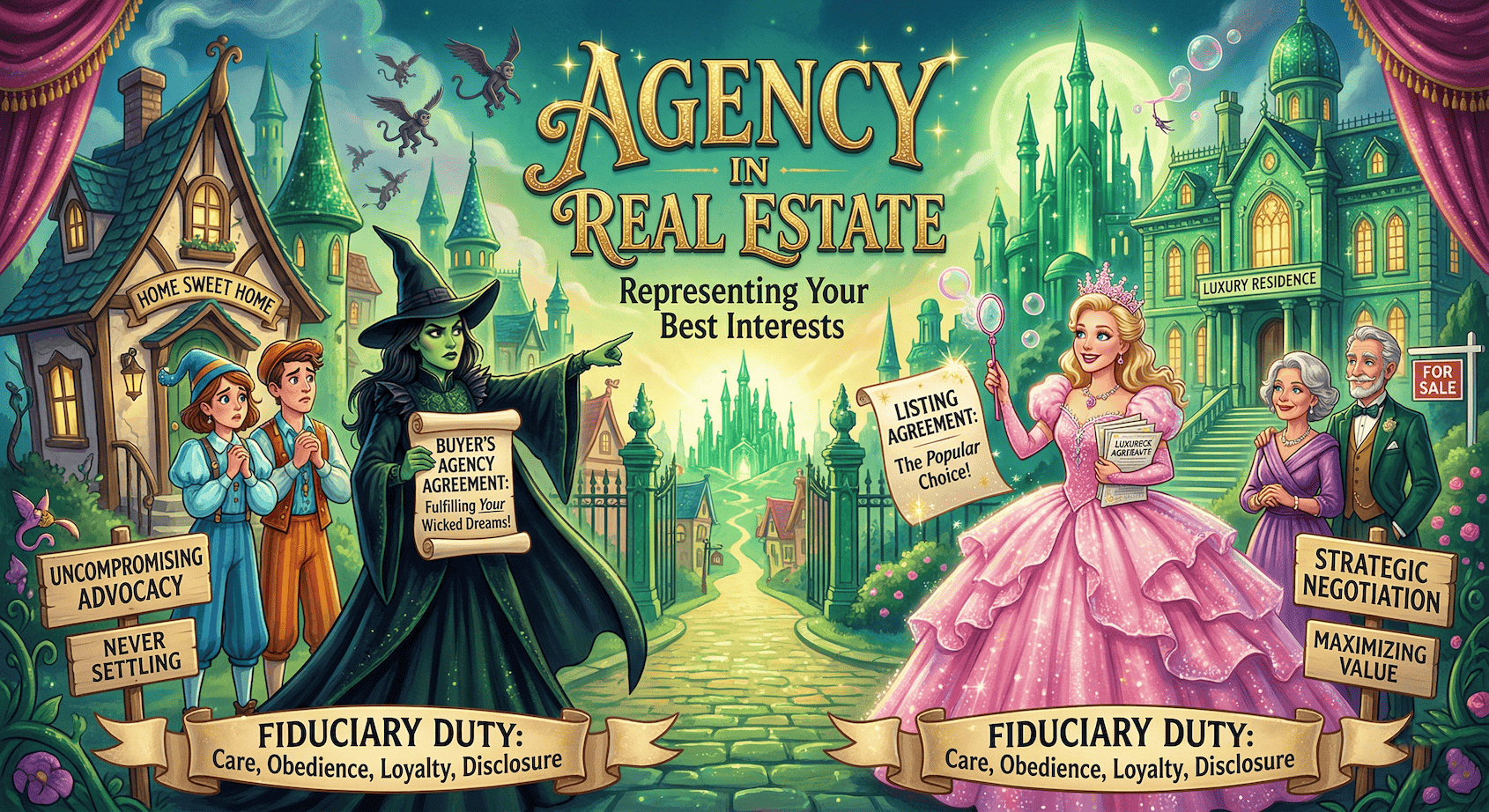
Cue the “Wicked” music here if it’s helpful, It’s time to try defining agency…
Agency is the legal relationship that tells you who represents whom in a real estate transaction, what duties are owed, and what information can and cannot be shared. It is not a slogan. It is the structure holding the deal together. California spells this out in Civil Code section 2079.16, and the state requires written disclosure of the relationship early in the process through the C.A.R. Agency Disclosure form.
Most consumers do not think about agency until something goes wrong. That is usually too late. The better move is to understand the roles before the first offer, the first counter, or the first argument over who said what.
Listing Agent
When an agent represents a seller, that agent is the seller’s agent. The agent owes the seller fiduciary duties, which means utmost care, honesty, integrity, and loyalty. The seller’s agent is supposed to market the property, help negotiate the deal, and disclose all facts known to the agent that materially affect the value or desirability of the property. California Civil Code section 2079.16
That sounds basic, but it matters. If a seller knows about a roof leak, foundation movement, or some other material issue, the seller’s agent cannot quietly hope nobody asks. If the agent knows it, it has to be disclosed. The listing agreement is not a magic shield. It is a contract with duties attached.
Selling Agent
For buyers, agency works the same way from the other side. A buyer’s agent owes the buyer loyalty, confidentiality, disclosure, and reasonable care. That means the agent should help the buyer understand the market, write the offer, navigate inspections, and avoid stepping on legal landmines. A buyer’s agent is not there to make the buyer feel good. The agent is there to protect the buyer’s interest while keeping the transaction moving.
That is where people get confused. A buyer’s agent still has to be honest with the seller and the other side on material facts. Agency does not authorize deception. It authorizes representation.
Double Agent
Then there is dual agency, which is where the whole thing gets more interesting and a little more dangerous. Dual agency happens when one brokerage, or one agent through a brokerage, represents both sides of the same deal. California allows it, but only with knowledge and consent from both parties. California Civil Code section 2079.21
This is the part consumers should pay attention to. In dual agency, the agent cannot disclose one side’s confidential information to the other without permission. That includes financial position, bargaining position, motivation, or willingness to accept more or less money. In plain English, the agent is still supposed to be honest, but the agent cannot become a messenger for secrets. That is why dual agency is often a compromise, not an ideal.
Agents need to understand this too, because dual agency is not just a disclosure issue. It is a risk management issue. It changes what you can say, what you can know, and how carefully you have to operate. If you do not understand the limits, you can create liability fast.
Cooperating Colleagues
Real estate agents work in a cooperative environment, but cooperation does not mean everybody is on the same team. Listing agents owe duties to sellers. Buyer’s agents owe duties to buyers. Cooperating agents are still expected to deal honestly and fairly with one another, but they do not owe each other loyalty. They owe each other professionalism.
That means no bluffing with information you should not have. No pretending you forgot the showing instructions. No trying to gain leverage by leaning on the other side in ways that are not allowed. If you are working in California, the rules around disclosure, offer presentation, agency confirmation, and compensation are stricter than casual office talk suggests. California Civil Code sections 2079.14 through 2079.24
Consumer Participants
Consumers should know this because what happens between agents affects you. If the professionals do not understand their roles, the transaction suffers. Delays, confusion, and disclosure problems usually start with somebody not knowing whose job it was to do what.
Sellers and buyers also have duties. They are not passive passengers. A seller has to disclose known material facts, read the listing documents, and cooperate with the process in good faith. A buyer has to review disclosures, conduct inspections, and protect their own interests. The law assumes both sides are responsible adults, even when everyone is acting like nobody told them anything.
That is why the paperwork matters so much. The C.A.R. Seller’s Advisory and Fair Housing and Discrimination Advisory are not just fill in the blank forms. They are reminders that the parties in a transaction are expected to understand what they are signing, ask questions, and seek legal or tax advice when needed.
Agency in Essence
The simplest way to think about agency is this.
The seller’s agent works for the seller. The buyer’s agent works for the buyer. Dual agents work for both, but with limits. Colleagues owe each other professionalism, not loyalty.
Sellers and buyers owe themselves attention, honesty, and diligence.
If that sounds too simple, good. Real estate works best when the basics are understood early and repeated often.
Agency Prevents Chaos
The worst transactions are not the dramatic ones. They are the confused ones. The seller who thought the agent was “handling everything.” The buyer who thought the agent was “just showing houses.” The colleagues who assumed a conversation was informal and harmless. The people who signed something they did not read because they trusted the vibe.
Agency is the antidote to that mess. It gives the deal boundaries. It tells everybody where the lines are.