
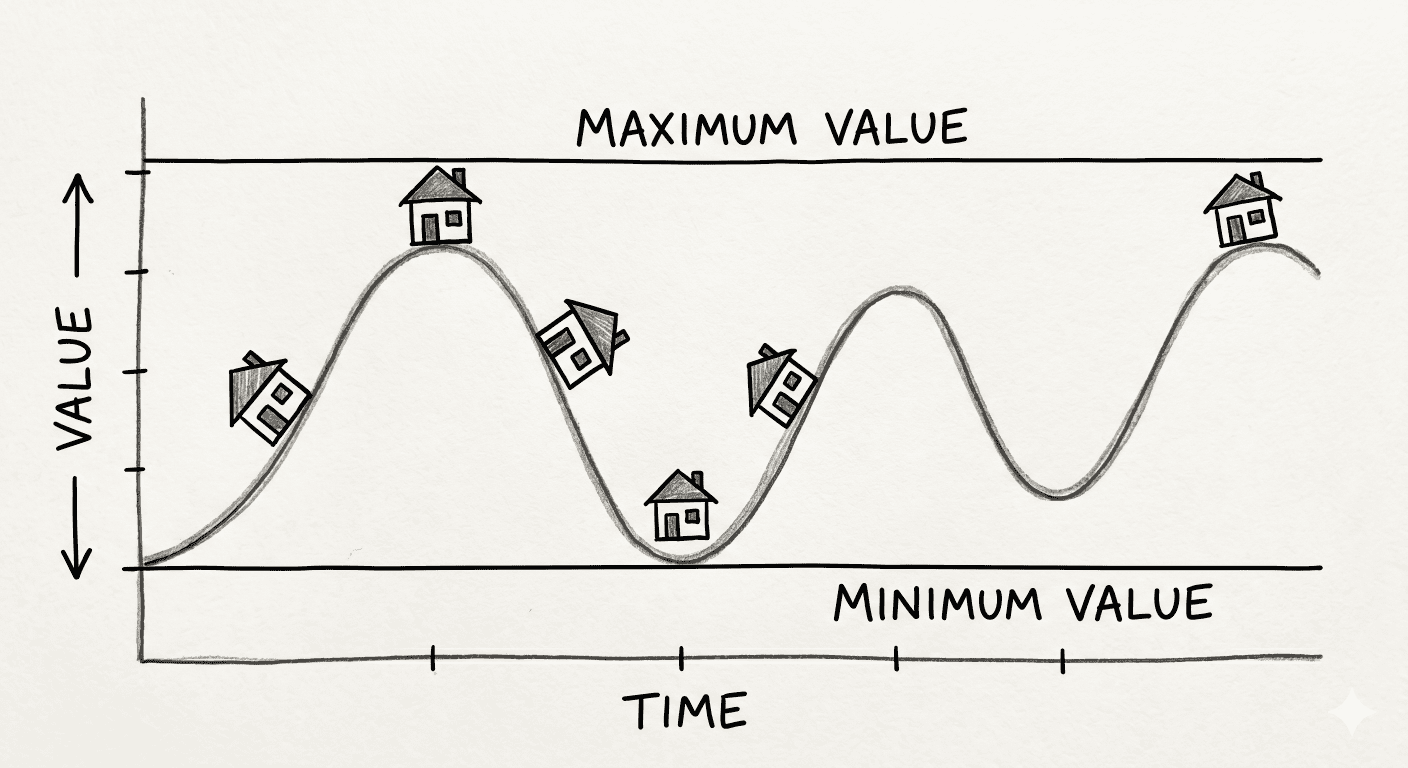
Though this is currently a big problem in California, this isn't only a California problem, and there is a solution.
Property tax assessments can be challenged nationwide. But California's solution, Proposition 8, (not that one the other one) is worth understanding, because it's one of the few tax mechanisms that actually works in a homeowner's favor when the market “corrects”.
California’s Proposition 13
Proposition 13 locked California property tax assessments at purchase price, with annual increases capped at 2%. It's why someone who bought in 1985 pays a fraction of what their neighbor pays for an identical home. That's the famous part.
What gets less attention, because it happens so infrequently in California, is what happens when values drop below that Prop 13 capped assessment. Homeowners end up paying taxes on a home worth less than the assessed value. That's where Proposition 8 comes in.
The Fix
Prop 8 specifically allows for temporary reductions when market values fall below a property's Proposition 13 capped value. During market downturns, this adjustment provides real relief by lowering tax burdens based on current market value rather than an inflated base rate. This was a common tool used by agents and property owners after the 2008 mortgage crisis.
The word "temporary" matters. The reduction isn't permanent. It lasts as long as the market value stays depressed. Once values recover and climb back above the Prop 13 capped value, the reduction disappears and the 2% annual increase resumes.
How It Actually Works
Every California county assessor is required to evaluate your property's market value as of January 1 each year. They compare it to your factored base year value (the Prop 13 calculation). If market value is lower, they're supposed to use the lower number.
In theory, this happens automatically.
In practice, most assessors don't flag it unless you ask. And the process varies by county in ways that make it confusing. Alameda calls it a "Decline in Market Value Request." Los Angeles uses "Decline in Value Review." Some counties treat it as automatic; others require formal filing.
Nationwide
Every state allows property tax appeals, but most have different rules.
North Carolina revalues properties every 4 to 8 years and you appeal during those windows. Missouri caps how fast assessments can increase. South Carolina does the same. Texas uses a protest process that varies by county. New York allows informal conferences.
How it Works
Gather evidence. Comparable sales from the last 60 to 90 days showing lower market value. Your county assessor will specify format, but recent sales of similar properties in your neighborhood are the gold standard. An appraisal works too, but it's expensive.
Check for errors. Request your assessment card from the assessor. Look for wrong square footage, misclassified bedrooms, incorrect property type, or outdated condition ratings. Errors are common and easiest to challenge. If you find one, that's a start.
Submit an informal request. Find your county's process—search "Decline in Value" or "Market Value Review" on the assessor's website. Most counties have a simple form. Submit it with your comparable sales. For specific guidelines on initiating a decline-in-value review in California, visit the California Board of Equalization website.
Know the deadline. Deadlines vary by county, but many allow informal review year-round. Don't assume you've missed your window—check your specific county. Missing a formal appeal deadline is irreversible.
If denied appeal. Most counties have a formal appeals process through the Assessment Appeals Board. You'll have a hearing, present your evidence, and they'll make a decision. Some cases settle; some go to hearing. Either way, you've documented your position.
Evidence
- Comparable sales showing current market value below assessed value
- Professional appraisal (expensive, but powerful)
- Photos showing condition problems or deferred maintenance
- Evidence of neighborhood decline, job losses, or infrastructure changes
- Historical assessment data showing inconsistencies
The stronger your evidence, the faster the assessor will move. A clear set of three recent comparable sales usually closes the conversation. This is where your, or a, real estate agent can add value.
The Bottom Line
An overassessment costs you money every year. On a $750,000 home, the difference between paying taxes on $885,000 versus $750,000 is roughly $1,400 annually in property taxes alone. Over five years, that's $7,000 you didn't have to pay.
Property tax assessments can be challenged nationwide, but California's Prop 8 gives you a specific tool most other states don't have. If your home is worth less than the assessment reflects, use it. The process is straightforward, and the evidence is simple to gather.
This content and many more of my articles are on my website’s blog: www.americasells.com/blog