
I love me some Quora; I like when people ask my advice about real estate and… cheating spouses. I got a question about adverse possession today, of real estate not spouses, and I have heard about adverse possession but haven’t experienced it in the wild; I know about it in theory but not practice.
We owe this week’s Real Estate 101, Adverse Possession, to a reader’s question on Quora.com; here’s my link if you want to check out my sagacious advice. Be warned I sometimes use common sense on cheaters.
What Adverse Possession Actually Is
Adverse possession is the legal mechanism that allows someone who is not the title owner to acquire ownership of land by occupying it for a period of time; It is not a loophole for squatters to steal houses out from under unsuspecting owners.
In California, it is one of the most difficult property rules to prove, and courts consider it strictly disfavored. The California Supreme Court has described it as a "harsh" doctrine that should be applied only when every element is proven by clear and convincing evidence, not a preponderance of the evidence.
Proof
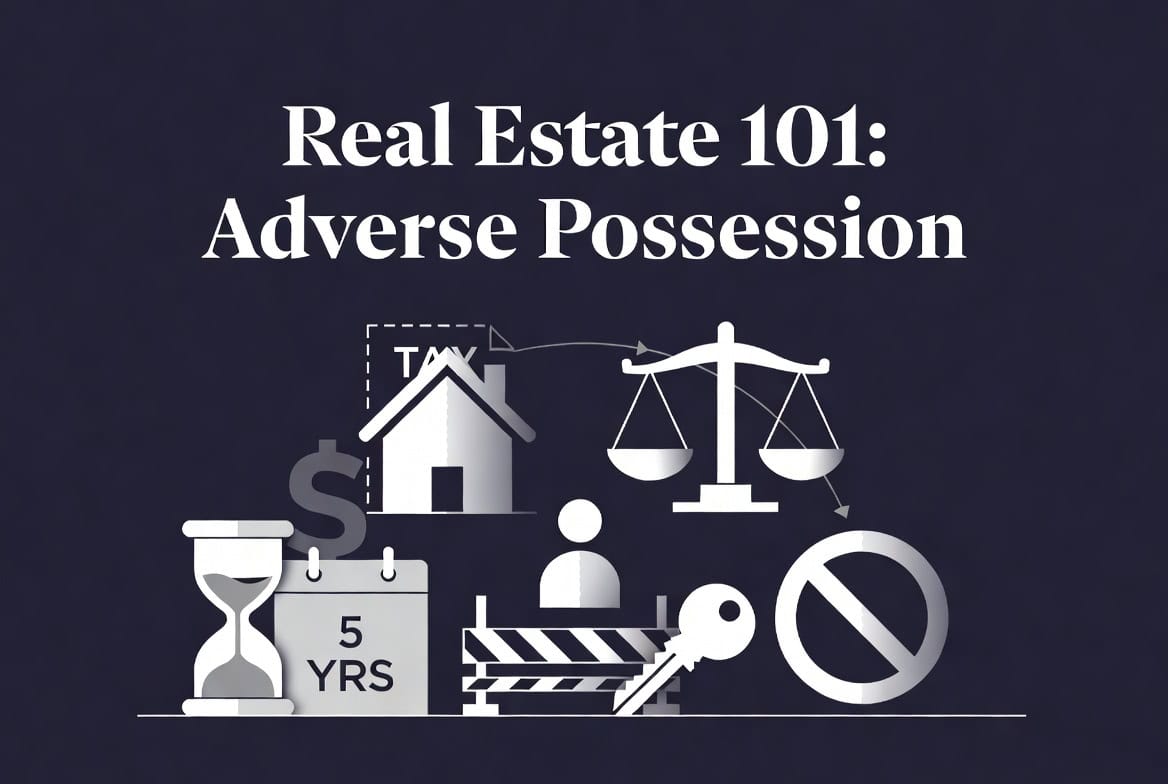
California adverse possession generally requires proof of five things: actual possession, open and notorious (I love it when you call me Big Poppa) use, hostile possession without permission, exclusive possession, and continuous possession for at least five years. The person claiming adverse possession also has to pay all property taxes assessed on the disputed property during that period.
The Five-Year Clock
The statutory foundation is California Code of Civil Procedure Section 325, which requires the claimant to satisfy five requirements simultaneously for an uninterrupted period of five years California Code of Civil Procedure Section 325. If even one element fails, the claim collapses.
Hostile and Adverse Possession
Hostile does not mean violent. In legal terms it means the occupant holds the property without the owner's permission and treats it as their own. If the owner gives explicit permission through a lease, license, or casual handshake agreement, adverse possession is legally impossible because the use is no longer adverse.
Actual, Open, and Notorious Occupation
The use cannot be secret. The law defines this in Section 325(a) as protecting the land with a substantial enclosure like a fence or keeping it usually cultivated (landscaping) or improved. A hidden shed in the woods does not count. The occupation must be visible enough to give the true owner reasonable notice that someone is using or owns the property.
Continuous, Uninterrupted Use
The clock starts when the occupant takes possession and runs for five consecutive years. If the true owner retakes control, files a quiet title lawsuit, or even enters the property and affirms ownership in a way that interrupts the possession (any acknowledgement that the squatter is there and isn’t supposed to be or is allowed), the clock resets to zero.
Property owners who periodically inspect their property and post no trespassing signs prevent an adverse possession claim before it can mature.
The Tax Requirement
The tax element is where most California adverse possession claims fail. The claimant must pay all state, county, and municipal property taxes levied on the land for the full five-year period. The payments must be timely, meaning made as the taxes come due each year. A lump sum payment for delinquent years does not satisfy the requirement.
The California Court of Appeal held in McLear-Gary v. Scott (2018) that a lump sum payment covering past delinquent taxes cannot be considered timely payment and does not fulfill the statutory requirement. The claimant must also prove these payments using certified records from the county tax collector, not statements or receipts.
If the actual legal owner is also paying property taxes on time, a claimant paying simultaneously generally cannot establish adverse possession because the owner's payment demonstrates their own claim of ownership.
This double payment rule creates a situation where a claimant must essentially pay taxes on property, they do not yet own in competition with an owner who is also paying. Most claimants cannot sustain this for five years.
What Cannot Be Adversely Possessed
Public lands cannot be adversely possessed. Government owned property, land held by public utilities, and property dedicated to public use are all exempt. This protection covers federal, state, and local government holdings, which means no amount of occupation can ripen into title against a public entity.
Real Estate Transactions
How to apply this in your practice if you’re a real estate agent? My advice is don’t.
Most adverse possession disputes that agents see involve boundary line disagreements where a fence, driveway, or landscaping has encroached onto a neighboring parcel for many years. These are rarely about a stranger claiming ownership of an entire parcel. They are about five feet of disputed yard that neither party was paying attention to for decades.
When a title search reveals a potential adverse possession issue during a transaction, the solution is usually a quiet title action, a boundary line agreement, or title insurance coverage depending on the circumstances.
A buyer who discovers that a neighbor's garage encroaches onto their potential property needs to address this before closing, not after. The neighbor may have a viable claim to that strip of land if they have occupied it openly and paid taxes on the entire parcel for the statutory period.
What Landowners Can Do to Protect Themselves
Landowners have tools to protect themselves; property inspections matter. A fence or no trespassing sign that is maintained and visible makes it much harder for a claimant to argue open and notorious occupation.
Posting signs that allow others to pass only with permission establishes that any use by a third party is permissive rather than adverse. If an unauthorized occupant is discovered, legal action should be taken promptly to interrupt the clock before the five-year period runs.
California law also gives landowners a specific tool through Penal Code Section 602. Property owners can file a formal no trespass letter with local law enforcement, granting police advance authorization to remove unauthorized occupants even if the owner is not present.
These letters remain valid for up to 12 months or up to 36 months if the property is permanently closed. This is a practical tool that every property owner should know about.
The Bottom Line
Adverse possession is one of those legal doctrines that clients (and me too) have heard of but almost never understand correctly. We imagine a squatter moving into a vacant house and taking ownership after some arbitrary period. The reality is far more demanding and far less dramatic. If you encounter this issue in a transaction, your first call should be to a real estate attorney who understands the specific procedural requirements in your jurisdiction. The statute of limitations and notice requirements vary, and the consequences of getting it wrong can affect title for decades.
My advice is straightforward. If your client discovers an encroachment or unauthorized use, act before the clock runs. Document everything. Check the county tax records to confirm who has been paying the taxes.
And do not assume the legal owner will prevail just because they have the deed. In California, the person who proves possession, payment, and open use for five years may end up with better title than the person holding the recorded grant deed.
This article and many more are available on my blog. America Sells