
ORIGINALLY PUBLISHED IN REALTYTIMES.COM FEB 2026
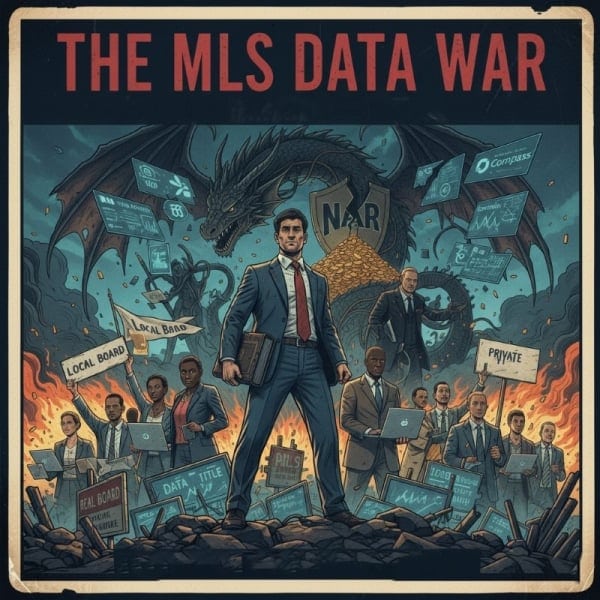
The data war is here, and local MLS boards are losing because they still think they're in the cooperation business. Local boards had the freedom to be cooperative because, for decades, the National Association of Realtors (NAR) guarded our data from non-members like a dragon resting on a pile of gold and the cost of access was membership.
Those of us on the inside treated our collective listing information as a public good to be (mostly) shared freely; the occasional “pocket listing” or “off market” sale was the exception not the norm. The off-market deals were between agents in an area being proactive and sharing information; they were broker tour gossip.
That philosophy built the industry, but it also built Zillow's $2.2 billion revenue empire . The time has come for MLS boards to reclaim their data, own their consumer relationships, and stop subsidizing their competition.
Built-in Problems
The problem is structural. The NAR settlement of 2024 didn't just change commission disclosure rules; it shattered the old model where the MLS was the sole, centralized marketplace. By banning the automatic posting of buyer broker compensation, the settlement forced critical transaction information off-platform. This fracture created exactly the opening private networks have been waiting for. Compass didn't accidentally defy Clear Cooperation; they strategically targeted the moment when the rules were weakest, understanding that each piece of data moved into the shadows diminishes the MLS's universal value.
Compass's July 2025 announcement that it would no longer adhere to the 24-hour listing rule was not a bluff. Their subsequent lawsuit against the Northwest MLS argues that forced sharing is an antitrust violation. If they win at the October 2026 trial, the entire foundation of cooperative sharing collapses. Both fractures—the separation of commission data and now listing data—are deliberate strategies to fragment the centralized marketplace that MLS boards built.
In California, Clear Cooperation is not merely a NAR policy—it is codified in California Civil Code §1086, which defines a listing as an agreement to submit to a multiple listing service. This legal foundation makes violations not just MLS rule breaches but potential breaches of licensee duty and fiduciary obligation.
Compass's strategy of training agents on the rules while encouraging individual choice creates knowing, willful violations that escalate liability from internal MLS fines to potential Department of Real Estate discipline.
Sidebar: Passing the Buck
In the San Francisco Bay Area, Compass encourages Clear Cooperation Policy violations by training agents on the rules while preaching the three-point sales system to clients. Compass is framing compliance as an individual choice.
This strategy allows the brokerage to maintain plausible deniability—they can claim they taught the rules—while shifting all liability for fines and sanctions onto the individual agents who choose to follow or break them.
By educating agents on what constitutes a violation, Compass ensures agents knowingly assume the risk, transferring legal exposure from the corporate entity to the individual. This is a designed risk-transfer contrivance that enables its private-first business model while protecting the firm's bottom line.
Follow Money
The evidence of what's at stake is already in the numbers. A 2025 analysis found that homes sold off-market through private networks fetched 17.5% to 18.6% less than comparable MLS sales.
In the Bay Area, that gap reached $302,000 per property . When sellers are convinced that exclusivity yields higher prices, they willingly leave money on the table. Agents who facilitate these private deals are not serving their clients; they are serving a corporate strategy that prioritizes control over outcome; Compass sells a disservice dressed up in exclusivity that manages to be harmful to their agents and clients.
This Means War
This is not abstract policy. It is a direct attack on the independent agent's livelihood. Small brokerages that cannot access private listings are shut out of the best inventory before it even hits the public feed. The agent who plays by the clear cooperation rules watches the firms that flout them capture the cream of the market. The playing field is being skewed, and MLS boards are watching it happen because their paralysis has become Compass's strategic vacuum.
Local boards are not simply exhausted by budget cuts and staffing shortages—they are being systematically disarmed. The chaos from the NAR settlement and the 2026 non-member access rule created the perfect distraction.
While boards scramble, Compass is building the alternative marketplace that will make the MLS irrelevant. They have forgotten that MLS data belongs to the brokers who belong to the board, not to the association as an institution.
This moment demands decisive enforcement of existing rules, not defensive reaction. The boards that survive will be those that reclaim their data sovereignty by aggressively auditing brokerages, fining the entity not just the agent, publishing compliance reports, and coordinating with the DRE to treat systemic violations as supervision failures.
Data Guerillas
Local MLS boards are being outspent and outmaneuvered. Compass can fund a federal lawsuit; Zillow spends billions on marketing and technology. The MLS board runs on a fraction of that budget, with part-time staff and volunteer directors.
While the local boards are stuck in compliance meetings, they’re building private networks, shaping algorithms, and fragmenting the marketplace. The lopsidedness isn’t accidental—it’s by design. They treat data as a proprietary weapon; we treat it as a shared utility. That mindset mismatch is why we’re losing.
Reclaiming Our Data
The solution isn’t to match their spending. It’s to reclaim what we already own. Our agents create the data; our boards hold the title. That inventory—fresh, verified, comprehensive—is ours, and it’s been taken hostage to someone else’s profit. It’s time to call it home.
That means aggressively enforcing existing rules (like California Civil Code §1086), imposing real penalties on brokerages that flout Clear Cooperation, and immediately investing in MLS-owned consumer portals that show the full market, not a curated feed. The data is ours. The infrastructure is ours. It’s time to act like it.